
Course Catalog
Structured Olympiad preparation from foundations to international competition level. Select a discipline to explore the curriculum.
Informatics Olympiad
IOIFrom fundamentals to IOI-level competitive programming in 14 weeks — taught by Ahnaf Shahriar Asif, BDOI Silver Medalist — 5th nationally, 2020
What You'll Learn
- Introduction to competitive programming: workflow, platforms, and resources
- C++ fundamentals: variables, data types, arithmetic, and I/O
- Conditional logic: if-else, comparison operators, and logical operators
- Loops, arrays, and strings: iteration patterns and data storage
- Functions, return types, vectors, and STL basics
- Recursion: base cases, Fibonacci, factorial, and the call stack
- Recursion vs loops: when to use each approach
- Big-O notation: constant, linear, quadratic, and logarithmic time
- Complexity analysis and the sweet spot rule for contest constraints
- Binary search: step-by-step implementation and logarithmic complexity
- Selection sort and merge sort: divide-and-conquer analysis
- STL sort() and counting sort for constrained values
- STL data structures: stack, queue, set, map, and priority queue
- Modular arithmetic: operations, factorial mod M, and Fermat's Little Theorem
- Binary exponentiation and modular inverse
- Divisibility, GCD (Euclidean algorithm), and LCM
- Permutations, combinations, and Pascal's triangle
- Sieve of Eratosthenes and prime factorisation
- Euler's Totient function, Euler's theorem, and extended Euclidean algorithm
- Chinese Remainder Theorem and counting divisors
- Prefix sums: 1D and 2D range queries in O(1)
- Difference arrays for range updates and bitwise operations
- Sparse tables for O(1) range minimum queries
- Segment trees: building, range queries, and point updates in O(log n)
- Choosing the right data structure for different query patterns
- Memoisation and bottom-up DP: Fibonacci, frog jumping, coin change, and tiling
- 0/1 knapsack, longest common subsequence, and DP state design
- Backtracking: permutations and N-Queens
- Graph representations: adjacency matrix vs adjacency list
- DFS and BFS: traversal, connected components, and shortest distances
- Trees: diameter, subtree sizes, and path queries
- Comprehensive review of all major topics and techniques
- Advanced topics roadmap: network flow, string algorithms, and geometry
- Effective practice strategies and the competitive programmer's mindset
- Online judge platforms and long-term preparation planning
Your Instructor

“Silver Medalist at the Bangladesh Olympiad in Informatics 2020 and Bronze in 2019, now competing in ICPC regionals while reading CS and Mathematics at BRAC University.”
Mathematics Olympiad
IMODevelop deep mathematical reasoning for BdMO, APMO, and IMO competitions — taught by Md. Golam Musabbir Joy, APMO Honorable Mention 2019
What You'll Learn
- Introduction to mathematical problem solving and proof strategies
- Fundamentals of arithmetic: primes, factors, and number properties
- Divisibility rules, tests, and applications
- GCD, LCM, and the Euclidean algorithm
- Modular arithmetic: congruences, residues, and clock arithmetic
- Fermat's Little Theorem and modular inverses
- Applications to cryptography and competition problems
- Counting principles: addition, multiplication, permutations, and combinations
- The Pigeonhole principle and its creative applications
- Inclusion-exclusion and double counting
- Algebraic manipulation: factoring, expansion, and simplification
- Solving equations: linear, quadratic, and systems of equations
- Advanced equation solving: substitution, symmetry, and polynomial roots
- Inequalities: AM-GM, Cauchy-Schwarz, and proof techniques
- Triangle properties: congruence, similarity, and special triangles
- Angle chasing: inscribed angles, cyclic quadrilaterals, and parallel lines
- Triangle centres: centroid, incentre, circumcentre, and orthocentre
- Ceva's theorem and Menelaus' theorem
- Circle theorems: tangent lines, power of a point, and radical axes
- Area and length: Heron's formula, coordinate geometry, and trigonometric methods
- Symmetry: reflections, rotations, and transformations in problem solving
- Mathematical induction: weak, strong, and structural induction
- Induction in inequalities and divisibility proofs
- Problem selection and time management in BdMO/IMO-style exams
- Proof writing: clarity, rigour, and presentation
- Full-length mock examinations and solution review
Your Instructor
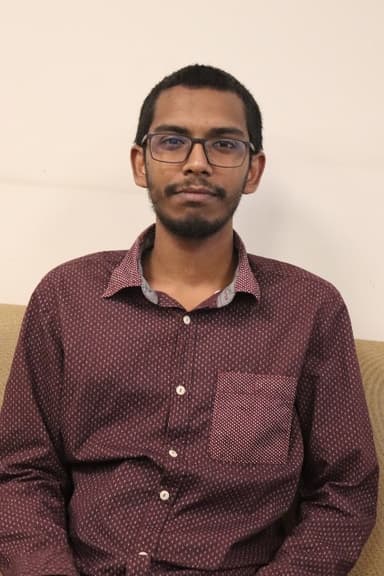
“Honorable Mention at the Asian Pacific Mathematics Olympiad 2019, winner of the Bangladesh National Math Olympiad from 2014 to 2017, and a TST camper in 2018 and 2019.”
Physics Olympiad
IPhOBuild deep physical intuition and problem-solving skills for BdPhO, APhO, and IPhO — taught by Adnan Alamgir & Muhtasim Ashab Dehan, First Bangladeshi to medal at IOAA
What You'll Learn
- Introduction to mechanics: units, vectors, and dimensional analysis
- Kinematics: displacement, velocity, acceleration, and projectile motion
- Newton's laws of motion, free body diagrams, and friction
- Work, energy, kinetic energy, and the work-energy theorem
- Applications of energy conservation: springs, inclines, and roller coasters
- Linear momentum, impulse, and elastic vs inelastic collisions
- Angular mechanics: torque, moment of inertia, and rolling motion
- Coulomb's law, electric field, and field line visualization
- Electric potential, potential energy, and equipotential surfaces
- Superposition principle for charges and fields
- Electric current, drift velocity, and Ohm's law
- Series and parallel resistors, Kirchhoff's laws
- Advanced circuit analysis: Wheatstone bridge, Thevenin and Norton theorems
- AC circuits: impedance, reactance, phasors, and resonance
- Magnetic force on charges and current-carrying wires
- Biot-Savart law and Ampere's law
- Electromagnetic induction: Faraday's law, Lenz's law, and motional EMF
- Fluid mechanics: pressure, buoyancy, Bernoulli's equation
- Thermodynamic laws, PV diagrams, and heat engines
- Carnot cycle, entropy, and efficiency
- Thermal properties of matter: specific heat, latent heat, and phase transitions
- Simple harmonic motion: spring-mass and pendulum systems
- Wave fundamentals: transverse, longitudinal, superposition, and standing waves
- Sound waves, Doppler effect, and intensity
- Geometric optics: reflection, refraction, Snell's law, and thin lenses
- Ray tracing, image formation, and optical instruments
- Wave optics: Young's double slit, diffraction, and thin film interference
- Photoelectric effect, Compton scattering, and wave-particle duality
- Bohr model, energy levels, atomic spectra, and quantum numbers
- Nuclear structure, binding energy, and radioactive decay
- Nuclear fission, fusion, and mass-energy equivalence
Your Instructors
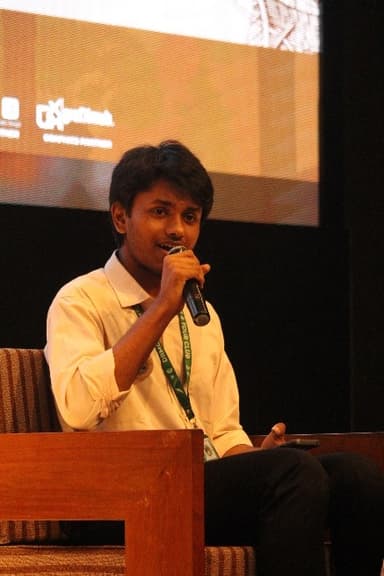
“First Bangladeshi to medal at the International Olympiad on Astronomy and Astrophysics, taking bronze in 2021 and silver in 2023, and National Champion at the 2024 Physics Olympiad.”

“Placed 4th nationally at the Physics Olympiad in 2022 and 3rd in 2023, earning selection to Bangladesh's Asian Physics Olympiad team. Reading EEE at BUET.”
Earth Science Olympiad
IESOExplore geology, atmospheric science, oceanography, and astronomy for IESO competition success — taught by Faiza Islam, IESO Team Bangladesh
What You'll Learn
- Mineral identification: crystal systems, hardness, lustre, and cleavage
- Rock cycle: igneous, sedimentary, and metamorphic rock classification
- Bowen's reaction series and magmatic differentiation
- Stratigraphy: principles of superposition, cross-cutting, and unconformities
- Geological maps: reading contours, dip, strike, and cross-sections
- Evidence for plate tectonics: paleomagnetism, seafloor spreading, and GPS data
- Plate boundaries: divergent, convergent, and transform with associated landforms
- Subduction zones: island arcs, volcanic arcs, and accretionary wedges
- Folds and faults: classification, stress analysis, and geological mapping
- Earthquakes: seismic waves, focal mechanisms, and magnitude scales
- Mantle convection and plume tectonics
- Atmospheric structure: troposphere through thermosphere
- Radiation balance: solar insolation, albedo, and the greenhouse effect
- Atmospheric dynamics: pressure gradients, Coriolis force, and geostrophic wind
- Weather systems: cyclones, anticyclones, and frontal analysis
- Climate classification: Koppen system and controlling factors
- Reading synoptic charts and satellite imagery
- Ocean structure: temperature, salinity, and density stratification
- Ocean circulation: surface currents, thermohaline circulation, and Ekman transport
- Tides: gravitational theory, spring and neap cycles, and tidal constituents
- Marine sediments: classification, distribution, and paleoceanographic proxies
- Coastal processes: wave dynamics, erosion, and depositional landforms
- Celestial mechanics: Kepler's laws, orbital elements, and perturbations
- Stellar evolution: HR diagram, main sequence, and end states
- Solar system: comparative planetology and formation models
- Planetary atmospheres and surface processes across the solar system
- Observational astronomy: coordinate systems, magnitude scale, and spectral classification
- Cosmology fundamentals: Hubble's law and the expanding universe
- Carbon cycle: reservoirs, fluxes, and perturbations
- Hydrological cycle: precipitation, runoff, and groundwater dynamics
- Biogeochemical cycles: nitrogen, phosphorus, and sulphur
- Paleoclimatology: ice cores, tree rings, and isotopic proxies
- Climate change science: evidence, attribution, and feedback mechanisms
- Natural hazards: risk assessment and mitigation strategies
- Mineral and rock identification practical tests
- Topographic and geological map interpretation exercises
- Meteorological data analysis and weather forecasting exercises
- Astronomical observation planning and coordinate calculations
- Full-length IESO mock written and practical examinations
- International Team Field Investigation (ITFI) preparation and teamwork strategies
Your Instructor
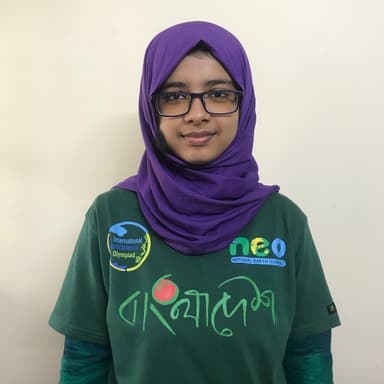
“Ranked 9th nationally at the National Earth Olympiad 2022 and selected for Bangladesh's International Earth Science Olympiad team, after four years of steady climbing.”
Economics Olympiad
IEOMaster micro, macro, and strategic reasoning for the International Economics Olympiad — taught by Riz Mohammad Hossain Khan, First Bangladeshi Gold Medalist, International Business Olympiad 2023
What You'll Learn
- Supply, demand, and market equilibrium
- Elasticity of demand and supply
- Consumer theory: utility maximisation and indifference curves
- Producer theory: cost curves and profit maximisation
- Welfare analysis: consumer and producer surplus
- Perfect competition and long-run equilibrium
- Monopoly: pricing, deadweight loss, and regulation
- Oligopoly models: Cournot, Bertrand, and Stackelberg
- Nash equilibrium and dominant strategies
- Sequential games and backward induction
- Applications: auctions, bargaining, and mechanism design
- National income accounting: GDP, GNI, and measurement issues
- Aggregate demand and aggregate supply framework
- The Keynesian multiplier and fiscal policy
- Money, banking, and monetary policy transmission
- Inflation, unemployment, and the Phillips curve
- Ricardian comparative advantage and gains from trade
- Heckscher-Ohlin model and factor endowments
- Trade policy: tariffs, quotas, and welfare effects
- Exchange rate determination and purchasing power parity
- Balance of payments and capital flows
- Trade disputes and WTO case studies
- Reading and interpreting economic data tables and charts
- Index numbers: CPI, GDP deflator, and real vs nominal
- Basic regression intuition and correlation vs causation
- Gini coefficient and Lorenz curve analysis
- Using data to evaluate policy effectiveness
- Structuring a business case: frameworks and communication
- Financial statement analysis: income, balance sheet, cash flow
- Market sizing and estimation techniques
- Competitive strategy: Porter's Five Forces and SWOT
- Present value, discounting, and investment appraisal
- Writing persuasive economic arguments under time pressure
- Past IEO economics round problems: timed practice
- Finance round: stock market simulation and portfolio reasoning
- Business case round: team-based case presentations
- Time management and question triage strategies
- Full-length mock IEO with peer review
- Post-mortem analysis and targeted revision
Your Instructor
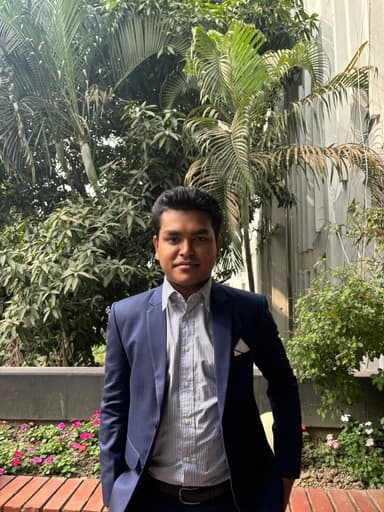
“First Bangladeshi to win Gold and place 3rd globally at the International Business Olympiad 2023, and first Bangladeshi Silver Medalist and International Best in Finance at the IEO 2022.”
Chess Olympiad
ChessFrom beginner fundamentals to tournament-ready strategy in 12 weeks — taught by Anata Choudhury, National Chess Player, Bangladesh
What You'll Learn
- Piece values, movement, and basic checkmate patterns
- King safety: castling, pawn shelter, and avoiding back-rank threats
- Piece activity: developing pieces to active squares
- Basic pawn structures: isolated, doubled, and passed pawns
- Elementary combinations: forks, pins, skewers, and discovered attacks
- Double attacks and deflection sacrifices
- Removing the defender and overloaded pieces
- Calculation technique: candidate moves and forcing sequences
- Combination patterns: Greek gift, Bxh7+ sacrifice, smothered mate
- Tactical puzzle training methodology and pattern recognition drills
- Opening principles: centre control, development, and king safety
- Building a White repertoire: 1.e4 systems and key ideas
- Building a Black repertoire: responses to 1.e4 and 1.d4
- Understanding opening traps and how to avoid them
- Transitioning from opening to middlegame: identifying key plans
- Weak squares, outposts, and piece placement
- Pawn structure strategy: pawn majorities, pawn breaks, and pawn chains
- The bishop pair advantage and good vs bad bishops
- Space advantage and how to exploit or neutralise it
- Prophylaxis: preventing your opponent's plans
- Studying master games: Capablanca, Karpov, and positional classics
- King and pawn endgames: opposition, key squares, and the rule of the square
- Rook endgames: Lucena and Philidor positions, rook activity principles
- Minor piece endgames: bishop vs knight, same-coloured bishop endings
- Queen endgames: perpetual check patterns and winning techniques
- Practical endgame decision-making: when to trade and when to keep pieces
- Clock management: time controls, time pressure strategy, and increment play
- Pre-game preparation: studying opponents and choosing openings
- Handling nerves: mental resilience and focus during critical moments
- Post-game analysis: identifying mistakes and building a study plan
- Full-length simulated tournament games with classical time controls
- Rating improvement strategy and long-term training planning
Your Instructor

“National chess player for Bangladesh and peak national No. 8 in 2024, ranked among the country's top 10 on the FIDE rating list.”